
The Human Advantage Series | Designing AI with Curiosity, Connection & Context
An AI executive and TEDx speaker on the three C's of human-centered design, why technology alone can't create a caring culture, and letting AI handle the chase while humans own the choice.

Welcome to this episode of The Human Advantage, a series where I talk with the people leaders and technologists shaping how organizations actually treat the humans inside them.
I couldn't have asked for a more fitting guest for episode 3 than Dr. Geanie Asante, an AI executive with more than 20 years in enterprise technology, leading engineering teams, global programs, and delivery transformation.
She's become a top voice on what AI actually means for the humans using it, not just the companies deploying it, backed by her TEDx talk, "Heart-Centered AI: How Opening to Vulnerability Revolutionizes Both Human and Artificial Intelligence," which draws on her own health journey to lay out the foundation for AI that actually understands and supports the people using it.
But what I loved most about our conversation was how practical she made it to keep humanity in the core of AI development, and how optimistic she is about what it’s unlocking for all of us at the individual level as well as the corporate one.
Here are the ideas I think every people leader should sit with.
The three C's framework behind human-centric AI design
I asked Geanie to walk me through the framework she keeps coming back to when she talks about human-centered AI design. Her answer was disarmingly simple.
“Curiosity is ask before assuming, connection is design with people, and context is understand the human consequences.”
Curiosity means talking to the people actually doing the work before you build anything, learning where they're frustrated and what they're afraid of losing. Connection means designing solutions with employees, not for them, and getting their feedback early instead of announcing a finished tool the day they're expected to use it. Context means recognizing that AI can process enormous amounts of information but doesn't automatically understand an organization's history, culture, or dynamics unless humans tell it.
“AI would then be our generalist, with the humans being the specialists. It's not just to make a smarter system, but a workplace where people feel more capable, where they feel trusted and more supported.”
For people leaders: Before you roll out any new HR tech, run it through the three C's. Interview the employees it will affect before you build, put them on the rollout plan instead of announcing it to them, and document the cultural and historical context the system can't infer on its own.
Technology can't fake a caring culture, but it can make care visible
I brought up a stat from her TED Talk that stuck with me: one in three employees feel their workplace doesn't genuinely care about their well-being. I asked how technology fits into fixing that.
Her answer surprised me. Technology, on its own, can't create a caring culture, but it can make an existing one visible. She pointed to something as simple as a walking-challenge app her team used, less about fitness and more about the bonds it let people form outside of work. But she was quick to add the catch: you can buy any platform you want, and employees will still feel unseen if leaders don't act on what it surfaces.
“The technology we use should help leaders notice, respond, and follow through. Technology makes the care visible.”
That's anonymous feedback tools flagging burnout trends, systems catching who's working after hours, and dashboards showing where people are struggling before it's too late. AI can remove the low-value admin work, but the real test is what a manager does with what's left behind, whether they redistribute the load or just let the data sit there.
For people leaders: Don't stop at the listening tool. Pair every pulse survey, workload tracker, or after-hours monitor with a defined manager follow-up step, so someone is accountable for acting on what it surfaces. The redistribution and the check-in are what employees actually register as care.
Let AI handle the chase, humans own the choice
We talked about where the worker-AI relationship is headed as agents get more capable. Geanie's framing was one of the best I've heard: agents should absorb the "coordination tax," the chasing, sorting, searching, scheduling, and formatting, and then hand it back with a clear suggestion for what's next.
“Make it a chief of staff for us, not an invisible boss. It can handle the chase, and as humans, we own the choice.”
It's a distinction worth sitting with. An agent that quietly makes decisions for you is a boss. An agent that clears your plate and lays out the options is staff. The critical thinking, the judgment calls, and the accountability stay with the human.
It's exactly the gap we built Caeli to close on the benefits side. Employees shouldn't have to chase down whether a procedure is covered, what's left in an FSA, or which plan actually fits a life change, that's coordination tax too. Caeli handles that chase, surfacing eligibility and coverage in plain terms, so employees spend their energy on the choice instead of the hunt for the information behind it.
For people leaders: Audit every AI tool your people touch by this test — is it removing the chase (research, paperwork, eligibility lookups), or is it quietly making the choice for them? The ones worth keeping, like Caeli on benefits eligibility, shorten the distance between a question and an answer without replacing the employee's judgment call.
Why she's optimistic: it's expanding agency
I asked what makes her hopeful about where AI takes us as a society, given how much anxiety is in the headlines right now. Her answer was about who gets to create.
She described watching a team member go from feeling behind because of his age to being "way ahead now," and a client who spent years and tens of thousands of dollars building a system that the two of them rebuilt together in thirty minutes.
“The teacher becomes the student, the student becomes the teacher. It's expanding agency.”
For people leaders: Build learning and development around tools your people already use daily, not a separate curriculum. The fastest confidence gains come from letting employees apply AI to their own real problems, not a training module.
The takeaway
Every answer Geanie gave came back to the same idea: AI's value isn't in what it automates, it's in what it frees people up to become, more curious, more connected, more confident. The organizations that get this right won't be the ones with the most tools. They'll be the ones that keep asking before assuming, designing with their people instead of for them, and remembering that the agent's job is to hand humans the choice, not take it from them.
That's the human advantage.
You can connect with Dr. Geanie Asante on LinkedIn and subscribe to her AI Insights newsletter, out once a week.
Put it to Practice
Vetted brands & products
Recommendations we genuinely stand behind — vetted for quality and benefit eligibility.
Continue learning
All articles
Benefits Maxxing
FSAFEDS Is Finally Getting a Debit Card in 2027: Here's How Federal Workers Can Maximize It
FSAFEDS says a Visa debit card is coming for the 2027 plan year, moving federal employees away from pure reimbursement-first FSA spending. Here's what's confirmed so far, and how to pair it with Caeli.

Benefits Basics
Open Enrollment 2027: Your HSA, FSA & LSA Game Plan
Open enrollment is the highest-paying 15 minutes of your year. Here's exactly how much to route into your HSA, FSA, and dependent care FSA for 2027 — plus the one number the IRS hasn't released yet.
Benefits Maxxing
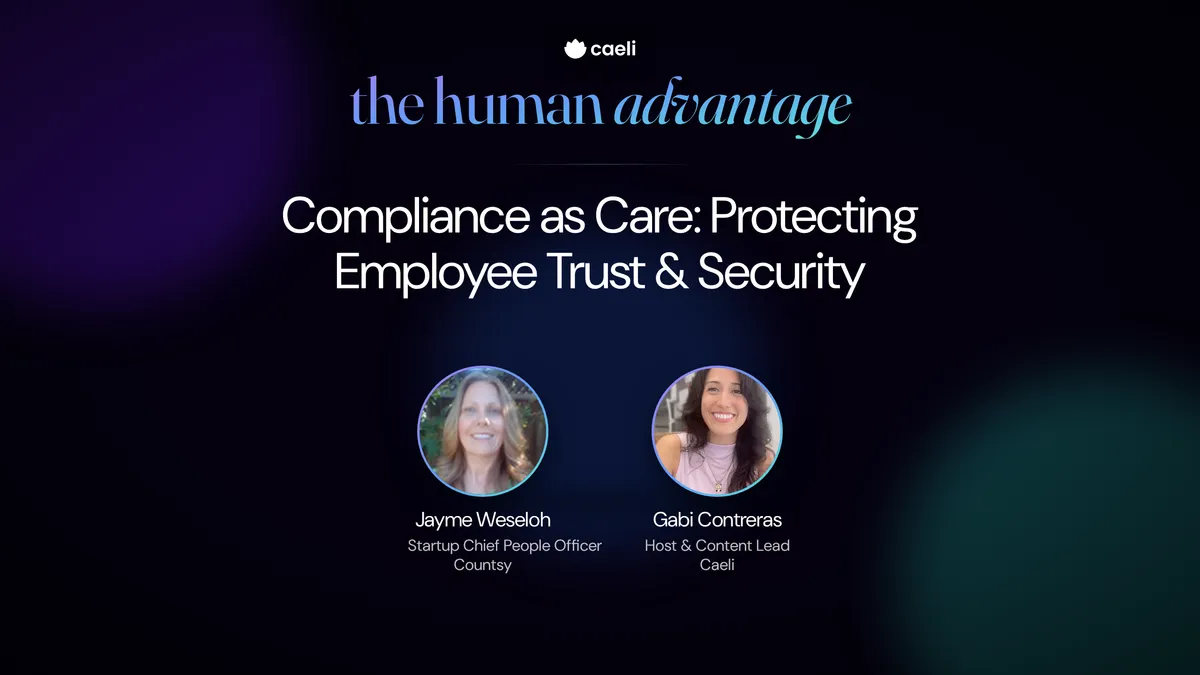
The Human Advantage Series | Compliance as Care: Protecting Employee Trust & Security
A conversation with Chief People Officer Jayme Weseloh on why protecting employee privacy is paramount, and how maximizing benefit utilization drives trust of everyone involved.