
The Human Advantage Series | Compliance as Care: Protecting Employee Trust & Security
A conversation with Chief People Officer Jayme Weseloh on why protecting employee privacy is paramount, and how maximizing benefit utilization drives trust of everyone involved.

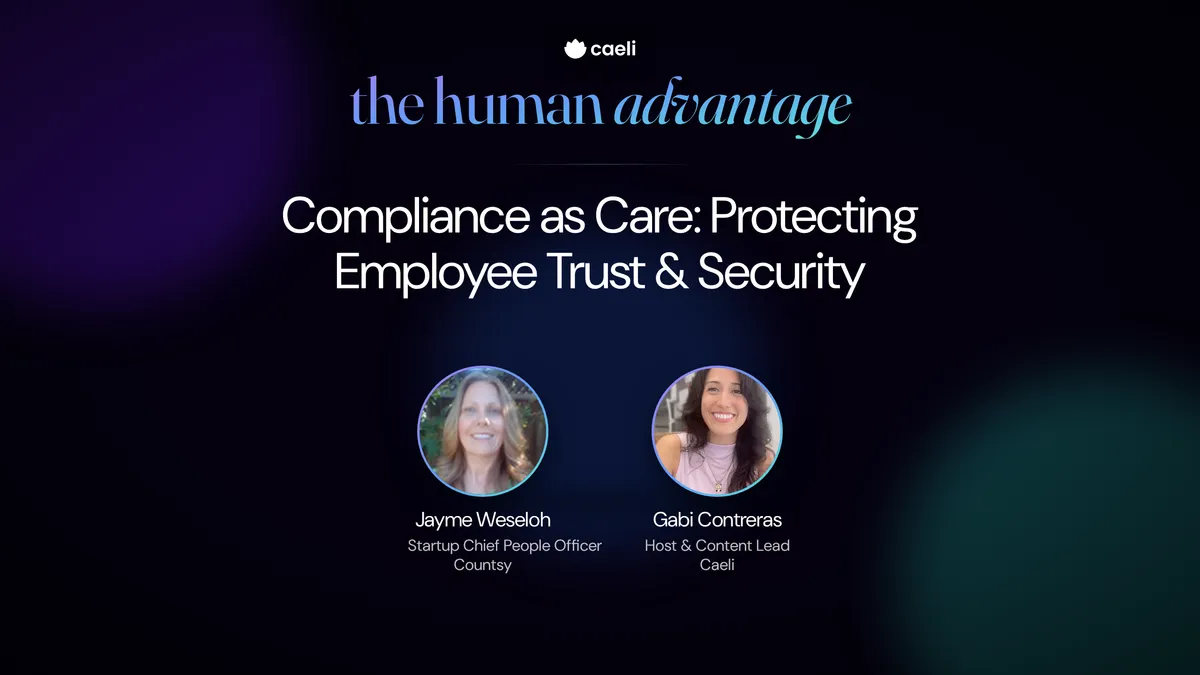
A conversation with Jayme Weseloh, Chief People Officer, for The Human Advantage Series.
Most companies treat compliance as a defensive crouch, a set of boxes you check so nobody gets sued. In the full episode, Jayme Weseloh makes the case for the opposite reading: compliance is a form of care, and the same guardrails that protect an employee's most sensitive information are what make people feel safe enough to be honest about what they actually need. Protect that data well and you protect the trust that everything else in a people function depends on.
That idea sat at the heart of our conversation with Jayme Weseloh. Jayme is a startup Chief People Officer with more than 18 years of experience building and growing some of the fastest-growing startups in Silicon Valley. Today she serves as a startup people officer with Countsy, one of the most trusted HR outsourcing firms, which has helped build the HR foundations for startups like Asana, Databricks, and Intercom. Across the conversation she walked us through what actually keeps people today, why so much of what companies offer goes unused, and why protecting employee data is what earns their trust in the first place.
The most durable way to keep people today
We started where most HR leaders' heads are right now: cost pressure. When budgets tighten and the question becomes what to keep and what to cut, what actually holds up? Jayme's answer was clear. What you keep is core.
That means medical, dental, and vision, the HSA tied to a high-deductible plan or the FSA that stands in for it, and the EAP. Those, she said, are essential and don't get touched. Right alongside them sits something that never shows up as a line item: manager support and manager training. And the third thing she refuses to cut is consistency of communication, keeping employees in the loop on how the business is doing, including the harder conversations about what might have to change.
"It might be a time cost, but it's not a bottom line budget cost. And when you're lean, your managers need more support."
So what gets exposed as noise? The perks that don't actually matter to employees. Swag was her first example. "Do they care about your swag? Probably not," she said. "They'd rather have more in their EAP or benefits program than get a jacket or a t-shirt." Reactive perks go too, the ones a company adds because a competitor did, without ever asking whether their own people wanted them.
It's a point that lands. Even the nicest branded jacket doesn't compete with quality benefits and a manager who is genuinely invested in your success. That gap, between what companies spend on and what employees actually value, is a big part of why Caeli exists: to help HR teams serve their people better without piling more onto their plate.
The benefits gap isn't a benefits problem
One stat we kept circling: roughly 30% of a compensation package goes unused, largely because it is so hard to navigate. What would it take to close that gap? Her answer, again, was communication.
"We do these open enrollments, and you have this huge packet, and people don't look at them," she said. Half the time the language is impenetrable. "Do you even know what an SPD is? It's a summary plan benefit document. No, they don't." What employees actually want is the high level: who's my provider, how much do things cost, where do I go, is there an app. Closing the gap means meeting them where they are, in their day-to-day, through a Slack channel, informal coffees, or open office hours, not a single annual meeting and a PDF.
"It's so key, just letting them know what they have. Because they usually don't know what they have."
This is also where technology earns its place. An AI benefits advisor can field the everyday questions that otherwise pile onto an HR team, and it can do it the moment the question comes up. As Jayme pointed out, a lot of people think about these things after work, late at night, or on the weekends. Instead of writing a note and waiting until Monday, employees get an answer right then, and only the genuinely complex cases get escalated to a person. It's exactly the load Caeli is built to carry.
Why HR actually wants a firewall
That last point, employees asking a tool things they'd hesitate to ask a person, opens onto the theme Jayme is most passionate about: privacy and compliance. Her position is that shielding employee data from the employer is good for both sides.
"It's not just health data," she said. "It's usually even family situations, a family emergency, a medical procedure, financial issues." When employees know that information is firewalled and separated from the people making decisions about their jobs, they are more open to actually talk to HR about it. And HR, in turn, has better information to help. The result isn't less visibility. It's more trust.
"When they know that information is firewalled or separated from the people making decisions about the employee, they're more open to talk to HR about it. It builds huge trust between your employees and your HR team."
The everyday stakes are real. Think of someone in the early weeks of a pregnancy who isn't ready to tell their manager but wants to understand what their HSA or FSA covers. Or someone managing a pre-existing condition they'd rather keep private but still needs to spend their benefits on. A tool that protects that information lets people use what they've earned without weighing it against what their manager might learn. As Jayme put it, it's still just with them. It's private.
Trust is built in the basics
We closed the substance on trust and technology more broadly. What earns trust as AI touches more of the employee experience, and what erodes it? Jayme's answer was refreshingly unglamorous: the basics.
Make sure onboarding is tight. Make sure payroll runs and people get paid. Make sure they get their health benefits when they're supposed to. Nothing erodes trust faster with a new hire than a paycheck that's wrong or late, a missing benefits card, not seeing themselves in the app, or adding a new dependent after a baby and not seeing that dependent show up. That, she said, is the first thing to break trust, which is why the basics have to come first.
"The thing that erodes trust quickest with a new hire is having a paycheck that is wrong, or they didn't get on time, or their health benefits."
Get the first 90 days right, get the fundamentals clean, and you've told employees the thing that keeps them: that they matter.
Rapidfire
We closed the way we always do, first instinct, no overthinking.
- One piece of advice for a brand-new People leader on day one? Listen. Go have a coffee, and not just with your leadership team. Have as many coffees as you can with different employees, hear the good, the bad, and the ugly, and meet people where they are.
- Finish the sentence: you know HR is working when nobody notices... when you don't hear anything from anyone. No issues, no troubles, and your inbox is suddenly really short.
- Where can people find you? Countsy.com is the easiest place to reach the team, or Jayme directly.
The takeaway
The thread running through everything Jayme shared is a simple reframe: employee care and compliance are the same project. Protect people's core benefits, communicate honestly, guard their private information, and get the unglamorous basics right, and you build the trust that makes everything else possible. It's less about spending more and more about making what you already offer actually reach the people it's for.
That's the whole reason Caeli exists. Roughly 30% of total pay lives inside benefits packages, yet so much of it goes unused, usually because people don't know what they have or how to tap into it. Caeli is an AI employee benefits advisor that meets people where they are: an eligibility checker, a shopping assistant, and a private place to get answers, so the value employees have already earned finally becomes something they can use.
Want to take better care of your people, with less pressure on your HR team? Install Caeli.
Put it to Practice
Vetted brands & products
Recommendations we genuinely stand behind — vetted for quality and benefit eligibility.
Continue learning
All articles
Benefits Maxxing
The Human Advantage Series | Nervous System Regulation & the Foundation for AI Literacy
Tamra Moroski, transformation specialist and Head of Partnerships at SmarterX, on the AI Intentionality Filter and reclaiming focus from constant AI use.

Benefits Basics
What Happens to Your FSA When You Leave Your Job? (2026)
Leaving a job means your FSA is use-it-or-lose-it — but a little-known rule lets you spend the full balance first. What you keep, what you lose, and how to save it in 2026.
Benefits Maxxing
The Human Advantage Series | Building Trust in Times of Change & Optimizing Benefit Usage
A conversation with a veteran Chief People Officer on running layoffs with integrity, helping employees see the benefits they already have, and staying human in the age of AI.