
The Human Advantage Series | Don't Wait for Burnout: Stress Management for High Performers
Sina Iten, founder of thymica Intreat, on learning stress, rest and recovery skills during a real work week, and the small daily habits high performers can start now.

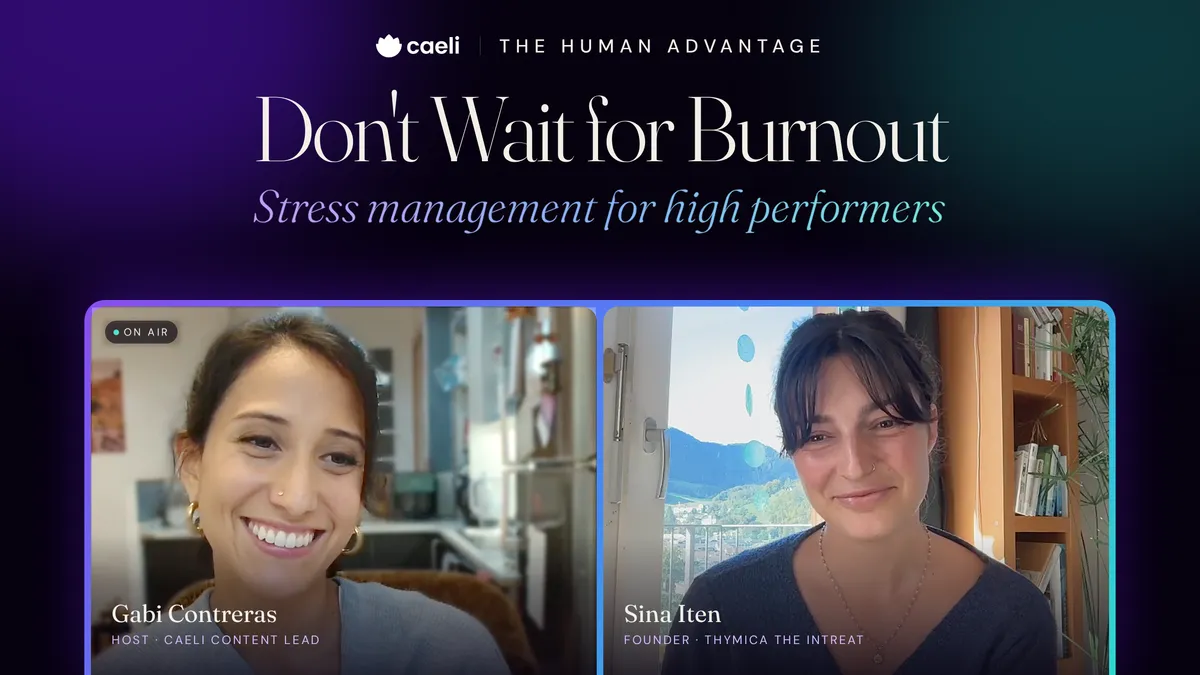
This is a recap of Episode 7 of The Human Advantage, Caeli's interview series on the future of work and building organizations that support the people inside them.
Welcome back to The Human Advantage, a series where I talk with the people shaping how organizations treat the humans inside them.
In episode 7, we talk about how to thrive in a fast-paced work life without burning out. My guest is Sina Iten, founder of thymica and creator of the thymica Intreat: a working retreat for high-performing professionals. You keep doing your job during the week, with your calls, deadlines and inbox, while you learn practical tools for managing stress, rest and recovery.
I'm not a neutral host on this one. Earlier this summer I joined a thymica Intreat myself. I kept my full work schedule, learned techniques like breathwork, and came home with tools I still use every day. I also left with a career realization I didn't expect, which I'll get to below.
Here are the ideas from our conversation that I think anyone in a demanding job should sit with.
What is an Intreat, and how is it different from a workcation?
The Intreat came from Sina's own overloaded years. Back in Switzerland she was a project manager, studying on the side and wanting to bartend at the same time. "A full schedule," as she put it. After several years of that she quit and went traveling through Asia, where she met breathwork teachers and people practicing all kinds of somatic tools.
Two encounters stayed with her: a Canadian man in his seventies who lived in the wilderness and shared how he calmed himself and handled his business life, and her friend Saira, a nutritionist she met at a surf camp, who introduced her to yoga and the chakras.
"There is so much knowledge I have no idea about, and I just want to share it with people."
The first Intreat happened without a plan. Sina and a friend in Ibiza, both feeling the pressure of their jobs, started meeting at the beach for sunrise meditation and yoga, then went back to their laptops for fully focused work, with no phones. Whenever one of them felt stressed, they took five minutes in the garden to breathe.
"I came back from Ibiza and I was like, wow, it didn't feel like work. It felt like a vacation."
After doing it five or six times, she noticed she kept those habits at home, and people started asking what she was doing differently.
So how is that different from a workcation? A workcation moves your work somewhere nicer. An Intreat is built around learning one practice, like meditation, breathwork or movement, and repeating it every day for a week while you work. Experts lead the sessions, and you learn alongside a small community. Most importantly, you learn it in the place stress actually happens.
"You are learning it while you are basically in your biggest stress environment, which is with your work. So you can take it home immediately."
You sometimes need to be taken out of your bubble to learn something new, and then it's easy to bring into your day-to-day.
For high performers: Retreats that ask you to unplug completely can be hard to carry back into real life. Look for ways to practice new habits during an actual work week, because that's where they need to hold up.
Inside an Intreat: a work week on an Arctic island
I asked Sina to walk through a typical day, using the Intreat I attended. We went to Fleinvær, a tiny, remote island in Arctic Norway. As Sina said, the remoteness is part of the method.
The week started with a shared dinner, and everyone got a thymica journal. The goal was to notice patterns: when you feel stressed, when you feel relaxed, what you were doing just before, and how you react after a tense meeting or a difficult email.
From there, each day followed a rhythm:
- Morning: breathwork or a grounding walk. No phone, just being present.
- Breakfast together, then four to five hours of focused work.
- Lunch break, then back to work.
- Evening: breathwork, sauna or a cold plunge to reset.
The most important practice wasn't on the schedule. Whenever someone felt anxious or stressed, the goal was to notice it, name it, step outside for a few minutes, look out at the Arctic and just be present.
I can vouch for how much that week changed. I hadn't realized how little I moved during my workday, or how much that added to my stress. Since the Intreat, walks are a regular part of my day. The bigger surprise was my career. I arrived expecting to put my head down and find new inspiration for the work I was doing. Instead, I realized I was forcing a path that wasn't serving me anymore, with clients who weren't a good fit. Seeing that clearly was worth as much as the stress tools.
Getting space from your routine shows you which stress you can manage and which stress you should walk away from.
For high performers: Try a stress journal for one week. Each time you feel tense, write down what just happened. The patterns tell you where to start.
Stress management you can start tomorrow morning
You don't need a plane ticket to begin. Sina's advice starts with awareness: notice what you do from the moment you wake up until you go to bed.
Notice what your body is telling you. Sina didn't realize how stressed she was until someone pointed out how she sat when work got intense, with her shoulders tense and high.
"I felt like my brain is fine, but my body language was definitely not."
Change the first and last hour of your day. Is the first thing you do scrolling your phone, or thinking about meetings and emails? Sina's biggest change was the evening: no screens for an hour before bed. That means no phone, TV or laptop. Instead she gets outside, meditates or reads.
"Falling asleep after you read a book compared to being on your phone, it's just a game changer."
Start smaller than you think you need to. If an hour feels impossible, start with thirty minutes. If you need your phone first thing, go to the bathroom and drink a glass of water first, then check it. I've found that even ten deep breaths before reaching for my phone helps set the tone for the day.
Don't work through lunch. Even fifteen minutes with your phone and laptop put away counts.
These steps matter because of how much is coming at us all day: notifications, Slack messages, emails, DMs. Small boundaries help you feel more connected to yourself and less on call to everyone else.
Many of the things that support this, like fitness, mental wellbeing and recovery, may already be covered by a wellness stipend or Lifestyle Spending Account (LSA) from your employer, depending on your plan. Most people don't know what theirs includes. That's the gap we work on at Caeli, an AI benefits advisor that shows employees the wellness dollars they already have so they can use them. We call it benefit-maxxing.
Awareness comes first. Once you notice the stress, small changes make a big difference.
For high performers: Pick one change for this week: thirty minutes without screens before bed, a glass of water before your phone, or a lunch away from your laptop.
What leaders can take from the Intreat model
I closed by asking what leaders and entrepreneurs should take from the Intreat model, especially those who set the tone for a team. Sina began with the line that sums up the whole episode:
"No business is working if you're not working."
And she was clear that leaders go first:
"As a leader, you're setting an example. If you are taking care of yourself, you want your employees to take care of themselves too."
Teams copy what leaders do much more than what they say. A leader who answers emails at midnight and skips lunch sets that standard for everyone. A leader who protects their energy gives the team permission to do the same. And Sina didn't stop at executives:
"Every company, every leader, every freelancer, every employee should know that without their health, it's not working anyway."
The point is to start before there's a crisis, not after:
"If our goal is to have a long, healthy, lasting mind, not just until this project ends, then start now."
For people leaders: Make your own recovery visible, by taking lunch, logging off and using your time off. Then audit which wellness and mental health benefits your team actually uses, and make them easy to find during your busiest seasons.
The takeaway
Sina's argument is that managing stress shouldn't wait until a project ends, the money is saved or you finally burn out. The Intreat works because it teaches recovery inside a real work week, so the habits hold up when you get home. You can begin without the island: notice your body, protect the first and last hour of your day, and step away at lunch.
As more work gets automated, the things only people bring, like clear judgment, presence and calm under pressure, matter more. Protecting them is the human advantage.
Learn more about thymica Intreat at thymica.com, or connect with Sina Iten on LinkedIn and Instagram at @thymicatheintreat.
Put it to Practice
Vetted brands & products
Recommendations we genuinely stand behind — vetted for quality and benefit eligibility.
Continue learning
All articles
Benefits Maxxing
FSAFEDS Is Finally Getting a Debit Card in 2027: Here's How Federal Workers Can Maximize It
FSAFEDS says a Visa debit card is coming for the 2027 plan year, moving federal employees away from pure reimbursement-first FSA spending. Here's what's confirmed so far, and how to pair it with Caeli.

Benefits Basics
Open Enrollment 2027: Your HSA, FSA & LSA Game Plan
Open enrollment is the highest-paying 15 minutes of your year. Here's exactly how much to route into your HSA, FSA, and dependent care FSA for 2027 — plus the one number the IRS hasn't released yet.
Caeli Picks
Best HSA/FSA Products for Fitness Enthusiasts
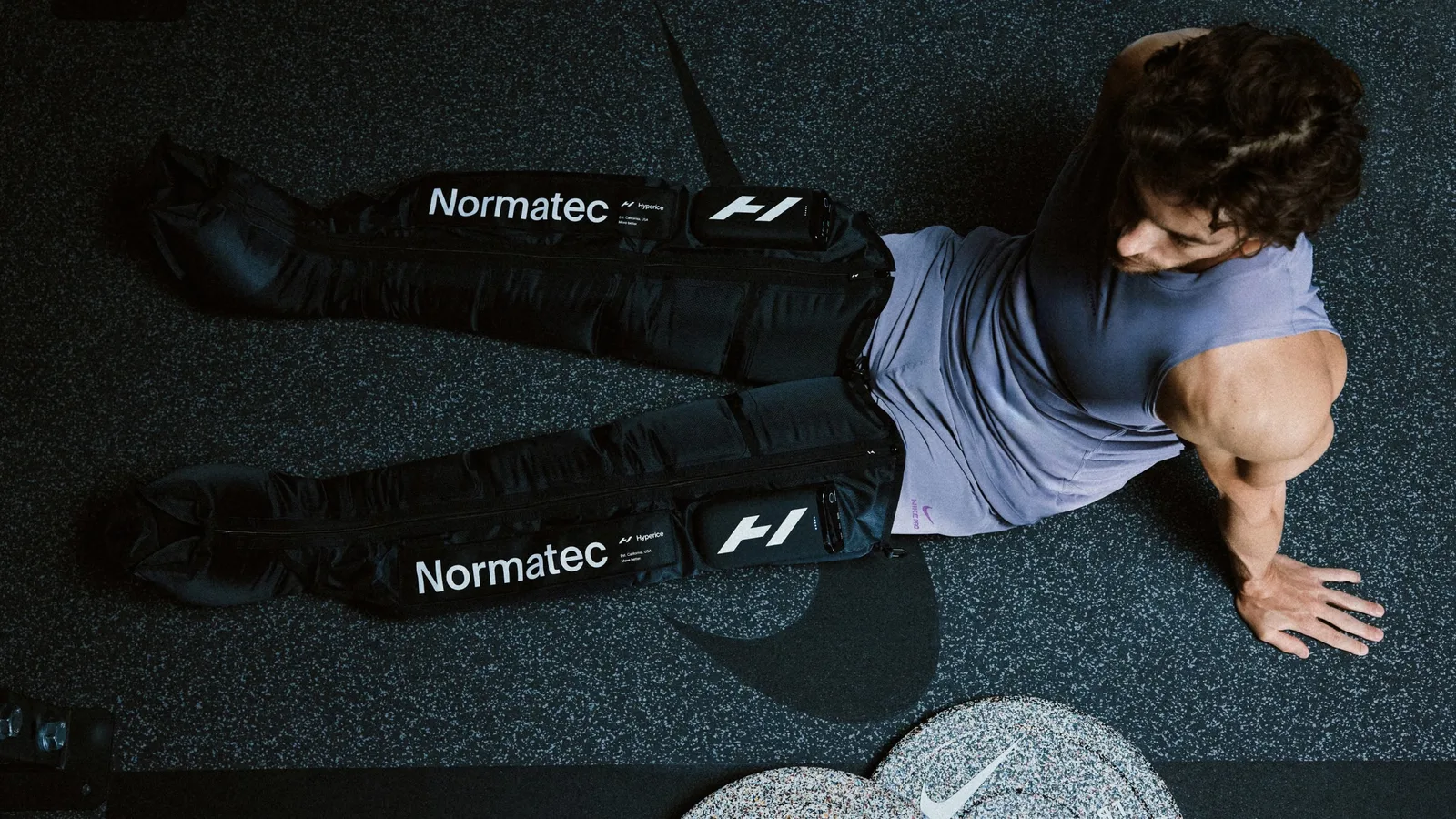
The recovery gear that used to live in pro training rooms is now home gear, and much of it can come out of your HSA or FSA with no paperwork at all. Here is what qualifies for someone who trains hard, what needs an LMN, and the one line the IRS won't cross.